· by Michael Blair, Nashville's Pressure Washing
A property manager searching for commercial concrete cleaning in Nashville is usually looking at a stained lot, a greasy dumpster pad, a drive-through lane or a row of delivery trucks, and the first questions are price and schedule. The question that can cost far more is where the water goes once it has lifted the oil and grime off the concrete. In Davidson County the answer is never the storm drain at the edge of the lot. Metro Water Services treats dirty pressure washing water in a storm drain as an illicit discharge, and Metro Code sets a fine for it by the day. This is how wash water is handled on the commercial and fleet washing we do, and what Metro’s own documents say about it.
Why the storm drain is off limits
Most people assume the grate in a parking lot leads to a treatment plant. It does not. Metro Water Services explains on its stormwater pollution prevention page that storm drains and pipes carry runoff directly to local waterways, and those waterways feed the Cumberland River, which is where the county’s drinking water comes from. The sewer that runs from a building’s sinks and floor drains is a separate system that does go to treatment. Water from a lot is clean enough for a creek only when it is rain.
Wash water off a commercial slab is not rain. It carries motor oil from parking stalls, grease and food waste from around a dumpster, tire residue, brake dust and whatever cleaner was used. The city’s Illicit Discharge Ordinance page, which carries Metro Code 15.64.205, declares non-stormwater discharges to the storm sewer or to community or state waters unlawful, and it counts unintentional releases such as leaks and seepage as discharges too. The listed exemptions include things like landscape irrigation and water line flushing, and individual residential car washing; a commercial wash is not among them. The civil penalty runs from fifty to five thousand dollars per day for each day of violation.
What Metro’s pressure washing guidance asks for
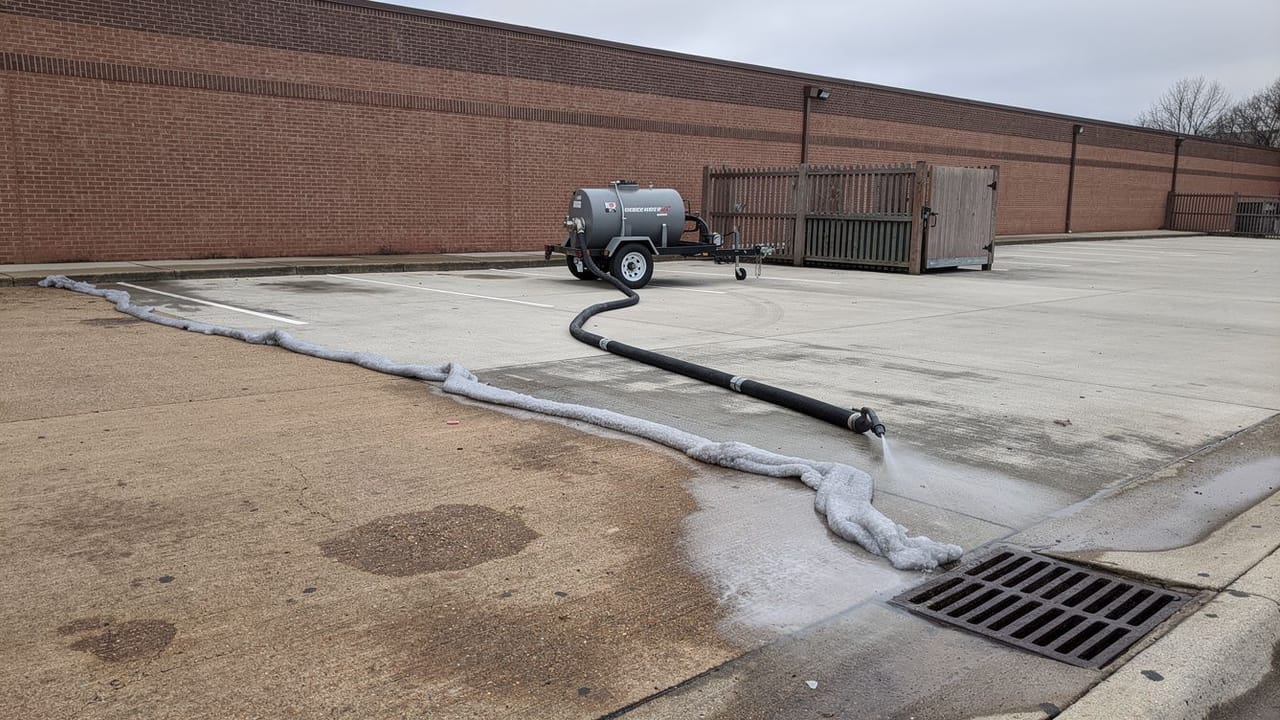
Metro Water Services published a short Pressure Washing Guidance sheet from its NPDES division, and it reads like a job plan. Before any water goes down, look at which way the site slopes and find every storm drain the water could reach. Dry-clean first: put absorbent on the oil spots and the grease around the dumpster, sweep it up and throw it in the trash, so the worst of it never meets water at all. Then send the wash water to one of three places, a grassy area, the sanitary sewer or a system that collects and captures it, and block the storm drains with something water cannot get through if they are in its path. The sheet also says to avoid soap where you can.
On a typical Nashville strip center or office lot, that plan turns into a few concrete steps for our crews. Drain covers go on the inlets downhill of the work before the surface cleaner starts. A berm steers the runoff to a low corner where a vacuum picks it up into a tank. The degreasing happens on the stains themselves, not across the whole lot, so there is less chemistry in the water to deal with afterward. And the order of work follows the slope, so clean areas do not get rinsed with dirty water from uphill.
- Map the slope and every storm inlet before the first pass
- Absorbent on oil and grease, swept up and bagged as trash
- Inlets covered or blocked with material water cannot pass
- Runoff steered to a collection point and captured
- Detergent only where the stain calls for it
Where captured water is allowed to go
Collected water still has to end up somewhere. Metro’s guidance gives the sanitary sewer as the usual place, with conditions. Solids are allowed to settle out or are filtered off and disposed of as solid waste. The water can then go into a cleanout, a mop sink, a toilet or a floor drain, with the property owner’s permission. If there is visible oil on it, more than a sheen, it goes through an oil and water separator first. Water from a heavily contaminated job, the sheet says, with heavy oil and grease, a pH that is very high or very low, solvents, lead-based paint, gasoline or a lot of sediment, is a job for an environmental waste company rather than a drain.
The joint Public Works and Metro Water Services Cooperative Discharge Directive explains why the sewer is the right place for it. Its stated goals are to keep contamination out of the storm system and to keep clean rainwater out of the treatment plant, and it cites a Tennessee rule that treats water used in any cleaning operation as sewage. It also speaks to properties that wash the same spot over and over. An area that gets periodic wash-downs, such as a dumpster enclosure or a truck bay, should drain to the treatment plant, with rain kept out of it by a berm, a curb or a raised pad, and a site with a grease trap should route the outside drains in that area to the trap. Any other treatment or discharge arrangement has to be approved by both Metro Water Services and the Public Works NPDES program.
The guidance does allow a narrow exception: water can go to a storm drain if no chemicals were used, the area was generally clean, the water looks clean with no sheen, and you are sure it is not polluting. A restaurant pad or a lot full of oil spots does not meet that test, and when there is doubt the sheet says to call 615-880-2420 before the water moves.
What to ask before a commercial wash is booked
A quote for a lot, a pad or a fleet should say how the water is handled, in plain words, and a manager should feel free to ask for it. Ask where the runoff will be collected and where it will be emptied, and whether that is a sewer connection on your property or a hauler. Ask what goes on the oil stains and whether the rest of the lot gets plain water. If the site has a grease trap or a separator, mention it, because that is often where the captured water belongs. Our guide to hiring a pressure washing company covers the general questions; on a commercial property this one comes first.
Fleet washing raises the same point in a smaller space. Trucks parked in your own lot drip oil and road film onto the pavement under them, and washing them where they sit sends that straight to the nearest inlet unless the water is caught. Scheduling helps: a regular wash on a set day lets the drain covers, berm and tank be laid out the same way each time, which is faster and leaves less to chance.
Once the slab is clean, some owners have the drive-through lane or the entry walk sealed so it stains less next time; washing, drying and sealing a concrete slab explains why the sealing happens on a later day. If you manage property in Davidson County, our pressure washing in Nashville page covers the area we work, and you can request a commercial estimate with the site address, the surfaces and any drains or traps you already know about.
Sources
- Metro Nashville Water Services NPDES Division, Pressure Washing Guidance — Pre-planning, dry cleanup, blocking storm drains, sanitary sewer disposal with the owner’s permission, oil and water separator, the storm drain exception, environmental waste company for heavy contamination
- Metro Nashville, Illicit Discharge Ordinance (Metro Code 15.64.205) — Non-stormwater discharges declared unlawful; exemptions; civil penalty of fifty to five thousand dollars per day
- Metro Nashville Public Works and Metro Water Services, Cooperative Discharge Directive — Keep contamination out of the storm system, wash-down areas routed to treatment, grease trap routing, joint approval for alternatives
- Metro Water Services, Stormwater Pollution Prevention — Storm drains carry runoff directly to waterways and the Cumberland River; reporting line 615-880-2420