
· by Michael Blair, Nashville's Pressure Washing
Most of the concrete sealing we are asked about in Brentwood and Franklin is a driveway, a back patio or a pool deck that has gone dull and started to stain, and the owner wants it cleaned and protected in one visit. It can be done in one job, but not in one day. A sealer locks in whatever is on the slab when it goes down, so the slab is washed first; it then has to dry all the way through, not just on top; and the sealer itself has to match the slab, because the product that suits a pool deck is the wrong one for a driveway that takes winter salt. Our concrete sealing page covers the service. This post walks through the sequence and the choice.
Why the slab is washed before anything goes on it
Concrete is porous, and over a few years the pores fill with fine dirt, tire residue, mildew and, on the shady side of a house, the green film our humidity grows on anything that stays damp. A film-forming sealer laid over that does not bond to the concrete; it bonds to the grime, and when the grime lets go the sealer peels with it. A penetrating sealer has the opposite problem. It works by soaking into the pores, and pores packed with dirt have no room for it, so it sits on the surface and does little.
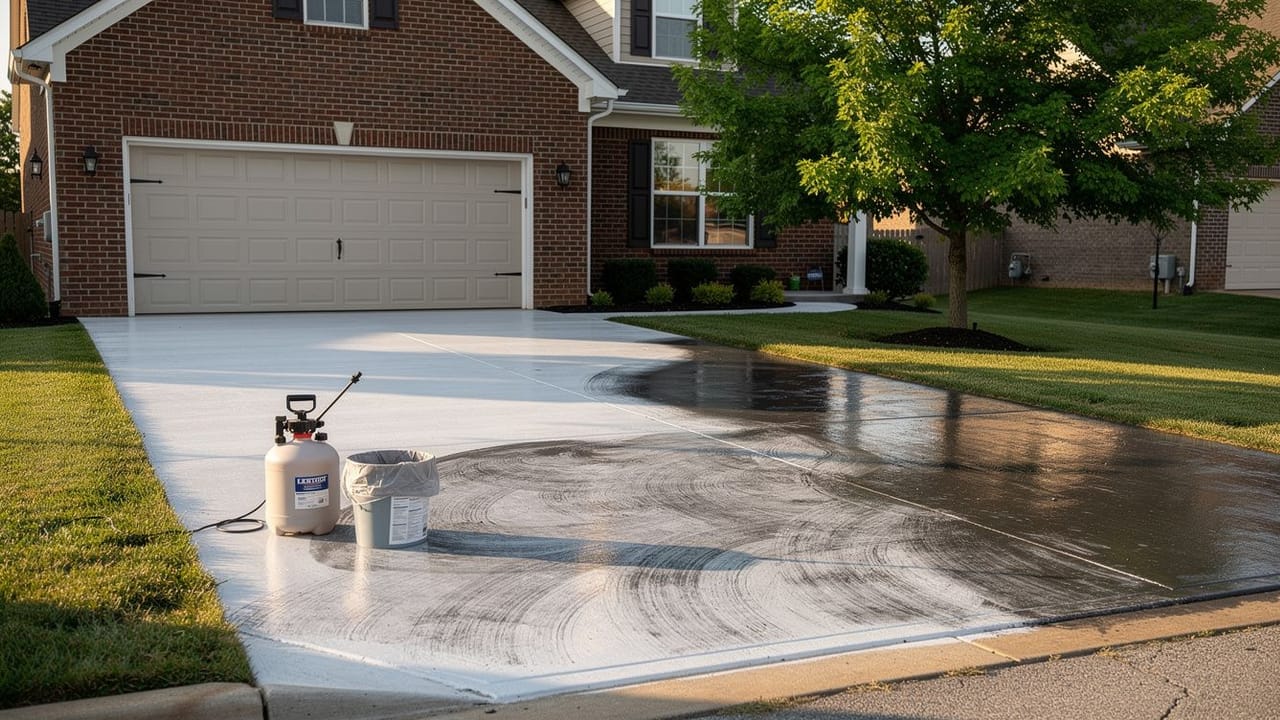
So our crews wash first, with a rotary surface cleaner for an even pass and a rinse that carries the loosened dirt off the slab instead of into the joints. Oil and rust spots get treated before the wash, because sealing over an oil stain keeps it there for good; the way we lift those is in getting stains out of a concrete driveway. The manufacturers say the same in their own instructions. Eagle Sealer’s Supreme Seal data sheet tells the applicator to make sure the surface is clean, dry and sound and to rinse it well with a pressure washer first.
How long it has to dry, and why dry to the touch is not dry
This is where most homeowner sealing jobs go wrong. Washed concrete looks dry within an hour or two on a sunny afternoon, but the water has only left the top. Foundation Armor’s Armor WB25 technical data sheet asks for at least 24 hours after washing and warns that water trapped in the pores causes trouble even when the surface feels dry. Eagle’s Supreme Seal sheet gives the same 24 hours. Ghostshield, on its Siloxa-Tek 8505 page, allows 24 to 48 hours after rain or pressure washing and sets a limit of 4 percent moisture by weight in the surface zone.
Trapped moisture shows up as a cloudy, milky film under an acrylic, or as a penetrating sealer that never soaks in. In Middle Tennessee the slab under a maple or along the north side of the house can stay damp well past a day, so we read the slab rather than the clock, and we wash one day and seal on a later one. Temperature matters as well. The Supreme Seal sheet calls for surface and air temperatures above 50°F and below 90°F, and the WB25 sheet gives 55°F to 85°F and suggests the early evening, as temperatures fall. A July afternoon slab can be too hot for either.
- Wash, then wait at least 24 hours, longer in shade or after rain
- No standing water and no damp patches left in the joints or low spots
- Air and slab inside the label’s temperature range for the whole application
- A dry forecast through the product’s stated drying time
Penetrating or film-forming, and where each one belongs
Concrete sealers come in two families. The Federal Highway Administration’s report Current Information on the Use of Overlays and Sealers puts it plainly: penetrating sealers travel down into the pores, and film formers make a layer on top. The report was written about bridge decks, but the distinction holds on a driveway. Penetrating sealers, silanes and siloxanes, leave the concrete looking about the same and shed water from inside the surface. The FHWA tech brief Materials-Related Distress: Hardened Cement Paste says that, applied properly, they drastically reduce water getting into the concrete.
That makes a silane or siloxane our usual pick for a driveway or a front walk that will see salt in winter, since keeping water and salt out of the pores is the whole job there. Film-forming acrylics are for appearance: a patio or a stamped and colored slab where the owner wants the color deepened or a wet look. The trade-off is traction. The same FHWA report notes that film formers can reduce skid resistance and wear under traffic, and the WB25 sheet warns that the cured acrylic may be slippery when wet. That matters most on a pool deck, where Foundation Armor suggests its fine non-slip additive mixed in at 3 to 6.5 ounces per gallon. A penetrating sealer leaves no film, so it adds no slickness of its own.
- Driveway or walk that takes winter salt: penetrating silane or siloxane
- Patio or stamped slab where color and sheen are the point: film-forming acrylic
- Pool deck: penetrating, or an acrylic with a non-slip additive mixed in
Resealing in a freeze-thaw climate, and the first-winter salt rule
Our winters swing above and below freezing over and over, and that is what flakes the top off a slab. The NRMCA’s CIP 2, Scaling Concrete Surfaces defines scaling as the flaking or peeling of a finished surface caused by freezing and thawing, and says slabs exposed to it with moisture or deicing salts are the ones at risk. It also gives a rule we pass on to anyone with a new driveway, and the subdivisions going in around Franklin and Brentwood have plenty of them: no calcium or sodium chloride deicer in the first year after the concrete is placed, and never a deicer made from ammonium sulfate or ammonium nitrate, which are fertilizer ingredients. Sand gets you through the first winter. If you are in Williamson County, our pressure washing in Franklin page covers the area.
How often to reseal depends on the family. The FHWA brief puts silanes and siloxanes at every 3 to 5 years. Acrylics wear faster: Foundation Armor’s guide How Long Do Concrete Sealers Last? gives 6 months to 3 years depending on traffic and exposure, and Eagle’s data sheet says to reseal as needed but no more often than every two years, so the coats do not build up. Built-up acrylic is the kind that peels and turns white, and stripping it is a much bigger job than the wash and reseal it replaced. When the water stops beading, or the sheen has worn through in the tire paths, it is time; ask us for a free estimate and we will look at the slab before saying which product it needs.
Sources
- Foundation Armor, Armor WB25 Technical Data Sheet — 24-hour dry time after pressure washing, trapped moisture in the pores, 55°F to 85°F application, slippery when wet and the non-slip additive
- Eagle Sealer, Supreme Seal data sheet — Clean, dry and sound surface, rinse with a pressure washer, 24 hours to dry, 50°F to 90°F, reseal no more often than every two years
- Ghostshield, Siloxa-Tek 8505 — 24 to 48 hours after rain or pressure washing; surface moisture no more than 4 percent by weight
- FHWA, Current Information on the Use of Overlays and Sealers (FHWA-HRT-16-079) — Penetrating and film-forming sealer types; film formers can reduce skid resistance
- FHWA Tech Brief HIF-15-018, Materials-Related Distress: Hardened Cement Paste — Silane and siloxane reduce water ingress; reapply every 3 to 5 years
- NRMCA, CIP 2 Scaling Concrete Surfaces — Freeze-thaw scaling; no chloride deicers in the first year; no ammonium sulfate or nitrate
- Foundation Armor, How Long Do Concrete Sealers Last? — Acrylic resealing every 6 months to 3 years