
· by Michael Blair, Nashville's Pressure Washing
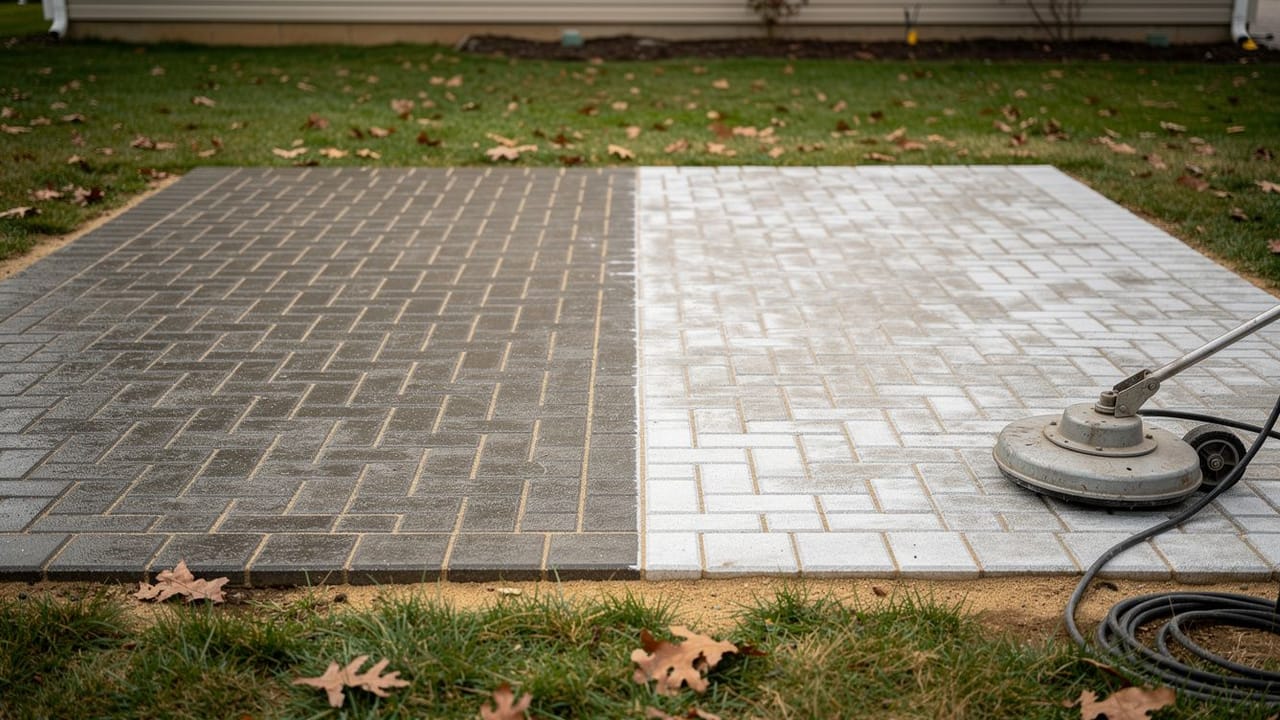
Paver patios, walks and driveways are all over Middle Tennessee, and the question we hear most about them is whether a pressure washer will blast the sand out of the joints. It can, if the work is done badly. The paver industry’s own technical guidance assumes a pressure washer is part of the job, and it is specific about what keeps the joints full: the spray pattern, the angle, the order of the steps, and what goes into the joints once the surface is clean.
Here is that guidance and how we follow it when we clean pavers as part of our driveway and concrete cleaning.
Can you pressure wash pavers without washing out the sand?
Pavers can be pressure washed without washing out the joint sand when the nozzle throws a wide spray and meets the surface at a low angle. The Concrete Masonry and Hardscapes Association’s technical bulletin on cleaning, sealing and joint sand stabilization of interlocking concrete pavement describes professionals working at 1,000 to 4,000 psi with a flow of 2 to 6 gallons a minute. It says a wide spray keeps sand from being washed out of the joints, and that a low angle of attack from that wide spray lowers the risk further.
What empties joints is a narrow tip held close and pointed straight down, which digs into the sand the way it would dig into soil. The same bulletin says that for the final rinse, a large amount of water matters more than high pressure. So our crews keep the wand moving across the pavers rather than along the joints, and rinse with volume rather than force.
Why are my pavers turning white?
Pavers turn white mostly because of efflorescence, a powdery deposit that forms as the cement in the pavers cures, and it is not a defect. The CMHA bulletin explains that water-soluble calcium hydroxide in the concrete moves to the surface and reacts with carbon dioxide in the air to form calcium carbonate, the white film. It says efflorescence does not affect the strength or durability of the pavers, that it can appear right away or months after installation, and that it can peak as soon as 60 days in.
Cambridge Pavingstones, a paver maker, writes in its guide to managing efflorescence that the haze shows most on dark pavers, disappears while they are wet and comes back as they dry. It calls the process natural and says rain will eventually wear it away, though nobody can say exactly when it will stop. If you want it gone sooner, both sources point to a cleaner made for concrete pavers, tested on a small hidden area first, since these cleaners contain acid. Cambridge adds that the haze can return while the reaction is still going on.
What order should a paver cleaning go in?
A paver cleaning goes stains first, then the whole surface, then the joints and any sealer, in that order. The CMHA bulletin lays it out: remove stains in specific spots, use a cleaner over the entire pavement for dirt and efflorescence, then stabilize the joints or seal if needed. It calls for products made for concrete pavers, a test patch, and following the label, because cleaners with strong acids can shift the color slightly.
Efflorescence cleaners, it says, go on with a low-pressure pump spray of 30 to 100 psi, sit for the time the product calls for, and come off with a water-only rinse. Results are judged after the area has dried for at least 24 hours. For a small patio or walk, the bulletin allows hand scrubbing and a garden hose instead, but warns against steel-bristle brushes, which shed bristles that rust and stain. Brass or plastic bristles are fine. Oil and rust spots work the way they do on a slab, covered in our post on getting stains out of a concrete driveway.
When is joint sand stabilizer worth adding?
Joint sand stabilizer is worth adding where water runs hard across the pavers or where they will be cleaned often, and the CMHA bulletin calls it optional for many installations. It notes that sand in the joints tends to firm up on its own over time as fine dirt works in. It recommends stabilization on slopes over 7 percent, and says it helps at downspouts and under eaves, where roof water lands on the same joints every storm.
If you do stabilize or seal, the surface has to be clean, dry and free of efflorescence first, and the joints have to be full and compacted, because a liquid stabilizer is meant to soak at least three quarters of an inch into the sand. Most sealers darken the pavers and deepen their color, the bulletin says, and some leave a gloss. Our concrete sealing page covers how we handle that step. If your pavers are in Brentwood or anywhere nearby, send us a few photos of the patio, the joints and any white haze, and we will tell you what the job needs.
Sources
- Concrete Masonry and Hardscapes Association, PAV-TEC-005-22 Cleaning, Sealing and Joint Sand Stabilization of Interlocking Concrete Pavement (revised 2022) — Order of work; 1,000–4,000 psi at 2–6 gallons a minute; wide spray and low angle keep joint sand in; 30–100 psi for efflorescence cleaners; rinse volume over pressure; no steel bristles; efflorescence cause and timing; stabilizers optional, recommended over 7 percent slope and at downspouts and eaves; liquid stabilizer penetration of at least 3/4 inch; sealers darken color
- Cambridge Pavingstones, Managing Efflorescence — Haze shows most on dark pavers and disappears when wet; natural and eventually washed away by rain; paver-specific cleaners contain acid and detergents; test a small area; may reappear while the reaction continues
FAQ
Pressure Washing Pavers Without Losing the Joint Sand — questions
How do you clean pavers without removing the sand?
Use a wide spray held at a low angle and keep it moving across the pavers, not along the joints. Paver industry guidance says a wide spray and a low angle of attack keep sand in the joints, and that a final rinse needs plenty of water more than high pressure. Refill any joints that did lose sand.
Can pavers be cleaned without a pressure washer?
Yes, for a small patio or walk. The paver industry’s cleaning bulletin allows applying a paver cleaner by hand, scrubbing, and rinsing thoroughly with a garden hose. It warns against steel-bristle brushes, which leave bits that rust and stain, and says brass or plastic bristles are acceptable for the scrubbing.
How do you get rid of white residue on new pavers?
Usually by waiting. The white film is often efflorescence, which is harmless and tends to wear away with rain. To remove it sooner, use an efflorescence cleaner made for concrete pavers, applied at low pressure and rinsed with water. Test a small hidden spot first, since these cleaners contain acid.
Should pavers be sealed after pressure washing?
Only if you want what sealer does. It is optional: it adds stain protection and usually darkens the color, sometimes with a gloss. If you seal, do it after stains, dirt and efflorescence are cleaned off and the pavers are fully dry, with the joints already full of sand.
How long does efflorescence last on pavers?
There is no fixed time. Paver industry guidance says it can appear right away or months after installation and can peak around 60 days, then remain for months while some of it wears away. A paver maker says rain eventually washes it off, though when it stops is hard to predict.