· by Michael Blair, Nashville's Pressure Washing
Older houses around Nashville often still have painted wood siding, trim or porch ceilings from before 1978, and once lead comes up, owners ask whether washing them is safe or even allowed. It is allowed. The federal lead rule does not ban washing, but on paid work it treats the wash like any other job that disturbs old paint: whatever comes off the wall, chips and water both, has to stay inside a contained area. Here is what the EPA has said about pressure washing, what an older HUD guideline added about the water, and what that means for a house wash on a pre-1978 home.
Can you pressure wash lead paint?
You can pressure wash a surface with lead paint on it, provided nothing that comes off leaves a contained work area. The EPA answered the question in a contractor FAQ that now survives only in the agency’s January 2021 web archive, since the page at its live address is gone. The archived answer says the Renovation, Repair and Painting rule does not ban pressure washing, and that the method falls under the same containment requirements as the methods the rule permits.
The containment it describes is not loose. Before the work starts, the firm has to close off the work area so that no dust or debris escapes while the job goes on, and the FAQ counts the waste water as part of that debris. The plastic has to stay whole for the length of the job, so a sheet that tears or slides out of place gets fixed. Washing is not a way around the rule, and it is not one of the banned methods, such as open-flame burning and unshrouded power sanding, listed in 40 CFR 745.85.
Is pressure washing allowed on pre-1978 houses?
Pressure washing is allowed on pre-1978 houses, and 1978 is where the federal rule draws its line. Under 40 CFR 745.103, target housing is housing built before that year, except housing for the elderly or people with disabilities and units with no bedroom, unless a child under six lives there or is expected to. Section 745.82 applies the rule to renovations done for pay in that housing and in child-occupied facilities.
Two things follow from that wording. The rule reaches paid work, so it governs a company washing your house, not you washing it yourself, although the flakes land in the same yard either way. And it stops applying when the paint is shown to be under the federal threshold of 1.0 milligram per square centimeter or 0.5 percent by weight, whether by a certified inspector or risk assessor, by a certified renovator with an EPA-recognized test kit, or by a lab testing paint chips. Without that result, we treat the paint on a pre-1978 house as if it contains lead.
What happens to paint chips when you pressure wash?
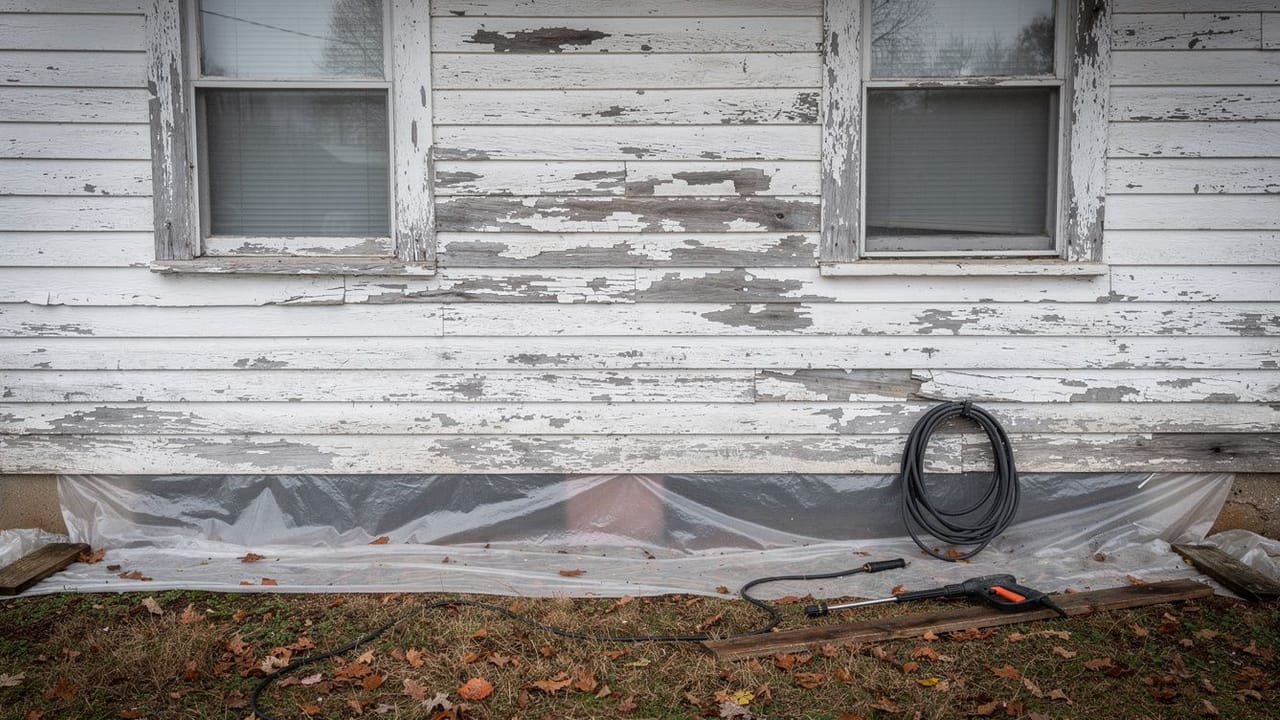
Paint chips knocked loose by a pressure washer ride the water down the wall and settle on whatever is below it, which is why the containment on an exterior job starts at the ground. The exterior work practices in 745.85 call for plastic laid out from the wall far enough to catch the falling debris, with vertical sheeting added where the work is close to a property line. When the job is done, a certified renovator has to inspect the work area and the ground below it, windowsills included, and repeat the cleanup until no dust, debris or residue is left.
HUD put more weight on the water itself in the 1995 edition of its Guidelines for the Evaluation and Control of Lead-Based Paint Hazards in Housing, chapter 4, an edition that has since been revised. That chapter listed power washing that cannot be contained as a prohibited practice on lead-based painted surfaces. Its alternative was to contain the exterior, collect all of the water, filter it, and dispose of the filter and the debris properly, with the soil or pavement covered for 10 to 20 feet around the building, sometimes less.
Where the wash water from old paint goes
Wash water from a wall with lead paint has to be collected and disposed of properly, and the archived EPA answer sends owners and contractors to their local water treatment authority for the details. In Davidson County that is Metro Water Services. Our post on where wash water goes in Nashville walks through Metro’s pressure washing guidance, which treats wash water carrying lead-based paint as a job for an environmental waste company rather than a drain.
On a house built before 1978 with painted siding or trim, we ask for the year it was built and whether the paint has ever been tested before we quote a wash. Without a test showing the paint is below the lead threshold, the containment and the water collection go into the price, along with the time they take. Send us the year and a few photos, and we will tell you what washing that house involves before any water touches the paint.
Sources
- U.S. EPA, How do RRP requirements apply to pressure washing? (Question 23002-17026), January 19, 2021 web archive — Pressure washing is not prohibited under the RRP rule; same containment as other permitted practices; no dust or debris, including waste water, leaves the work area; plastic kept intact; dispose of waste water properly and check with the local water treatment authority. The live page no longer exists; this is the archived copy.
- eCFR, 40 CFR 745.85, Work practice standards — Exterior containment, prohibited and restricted practices, and the certified renovator’s visual inspection of the work area and the ground below it
- eCFR, 40 CFR 745.82, Applicability — Rule applies to renovations performed for compensation in target housing and child-occupied facilities; exceptions where testing shows paint below 1.0 mg/cm2 or 0.5 percent by weight
- eCFR, 40 CFR 745.103, Definitions — Target housing as housing built before 1978, with its exceptions
- U.S. HUD, Guidelines for the Evaluation and Control of Lead-Based Paint Hazards in Housing, Chapter 4 (1995 edition) — Uncontainable power washing on lead-based painted surfaces listed as a prohibited practice; containment, water collection, filtration and disposal as the alternative; ground covering 10 to 20 feet. An older edition since revised.
FAQ
Pressure Washing Lead Paint on a Pre-1978 House — questions
Is power washing lead paint legal?
Yes. An EPA answer kept in its January 2021 archive says the Renovation, Repair and Painting rule does not ban pressure washing. On paid work at a pre-1978 house, though, it needs the same containment as any permitted method, so no dust, debris or waste water leaves the work area.
How do you check for lead paint before pressure washing?
The federal rule accepts three ways: a certified inspector or risk assessor, a certified renovator using an EPA-recognized test kit, or a lab analysis of paint chips. Paint below 1.0 milligram per square centimeter or 0.5 percent by weight is outside the rule. Without a test, paint on a pre-1978 house is treated as lead paint.
Does the lead rule apply if I wash my own house?
The EPA rule applies to renovations performed for compensation, so it governs a company you pay to wash a pre-1978 house rather than an owner washing their own. The chips and water that come off old lead paint land in the same yard either way, so containing them is still worth doing.
What do you do with wash water from lead paint?
Collect it rather than letting it run off. The archived EPA answer says to dispose of it properly and check with the local water treatment authority. In Nashville, Metro Water Services’ pressure washing guidance treats wash water carrying lead-based paint as a job for an environmental waste company, not a drain.