
· by Michael Blair, Nashville's Pressure Washing
Most washing around Nashville and Franklin happens between spring and early fall, but driveways, walks and siding keep getting dirty after the leaves come down, and owners ask whether the work can be done now or has to wait. Winter washing is possible. The cold changes two things about it: what happens to the water left on and in the concrete, and what happens to the water left inside the machine. Neither comes down to one magic temperature. Here is what an equipment maker and the Federal Highway Administration do say, and how it shapes our driveway and concrete cleaning in the colder months.
Is it safe to pressure wash when temperatures drop below freezing?
Not when the water you put down will freeze before it drains and dries, because then you are making ice where people walk and wetting concrete just before it freezes. Cold-weather washing is a matter of timing: the job has to leave enough hours above freezing for the surface to drain and dry before night.
We do not work to a single cut-off number. We looked for one in primary sources, an equipment maker’s manual or a federal guide that names a temperature below which washing should stop, and found none we could cite. What the sources do describe are the two ways a freeze does damage: water freezing inside the machine, and water freezing inside wet concrete. So we plan around the forecast for the hours after the wash, not just the reading when we start.
Ice is the plain hazard. A walk or set of steps washed late on a cold afternoon can be a sheet of ice by morning, which is worse than the dirt was. Our post on the slippery green film on a shaded sidewalk is about a slip hazard washing removes; a winter wash should not leave a new one behind.
Why does wet concrete matter before a freeze?
Because how saturated concrete is when it freezes decides whether the freeze harms it. The Federal Highway Administration’s tech brief on air entrainment and concrete durability explains that concrete saturated below a critical level is not damaged by freezing and thawing, because enough of its larger pores are still empty to take up the pressure as ice forms. The same concrete frozen while critically saturated, which the brief puts somewhere between 75 and 91 percent, can be damaged in a single freeze-thaw cycle.
The brief also describes how water gets in. It is drawn first into the smallest pores; the larger air voids, which are the relief space, are the last to fill, and under the brief’s test conditions that slower filling can take months to years. Air-entrained concrete is made with those voids on purpose. The brief is written about pavements, so we take the mechanism from it, not a rule about any one driveway.
What we take from it is simple: do not hand a freeze more water than it needs. In cold weather we wash concrete when it can drain and dry before the night drops below freezing, keep rinse water from pooling at slab edges and low spots, and leave the job for another day when a hard freeze is due that night. Our post on washing, drying and sealing a concrete slab covers drying time when a sealer is to follow.
What happens to a pressure washer left out in the cold?
Water trapped inside it can freeze and crack parts, and at least one maker will not cover that under warranty. Simpson’s operator’s manual for its King Brute hot-water pressure washer says its warranty does not cover damage caused by freezing, and that the burner coil warranty excludes a coil that froze and burst because the unit was left in an unheated building.
The same manual sets out its winterizing steps for storing or hauling the machine in freezing weather: shut off and disconnect the water, drain the machine, and pump a 50 percent solution of permanent-type antifreeze through it until it flows from the wand, working the trigger so it reaches the unloader. Before the next job the antifreeze is pumped back out into a clean bucket, because the manual warns it can damage paint. That is one manufacturer’s manual for one line of machines; every washer has its own, and the maker’s manual is the one to follow.
Hoses, guns and surface cleaners hold water too. Before a cold night we drain everything that held water, and the machine does not sit in an open trailer to freeze.
When winter washing makes sense
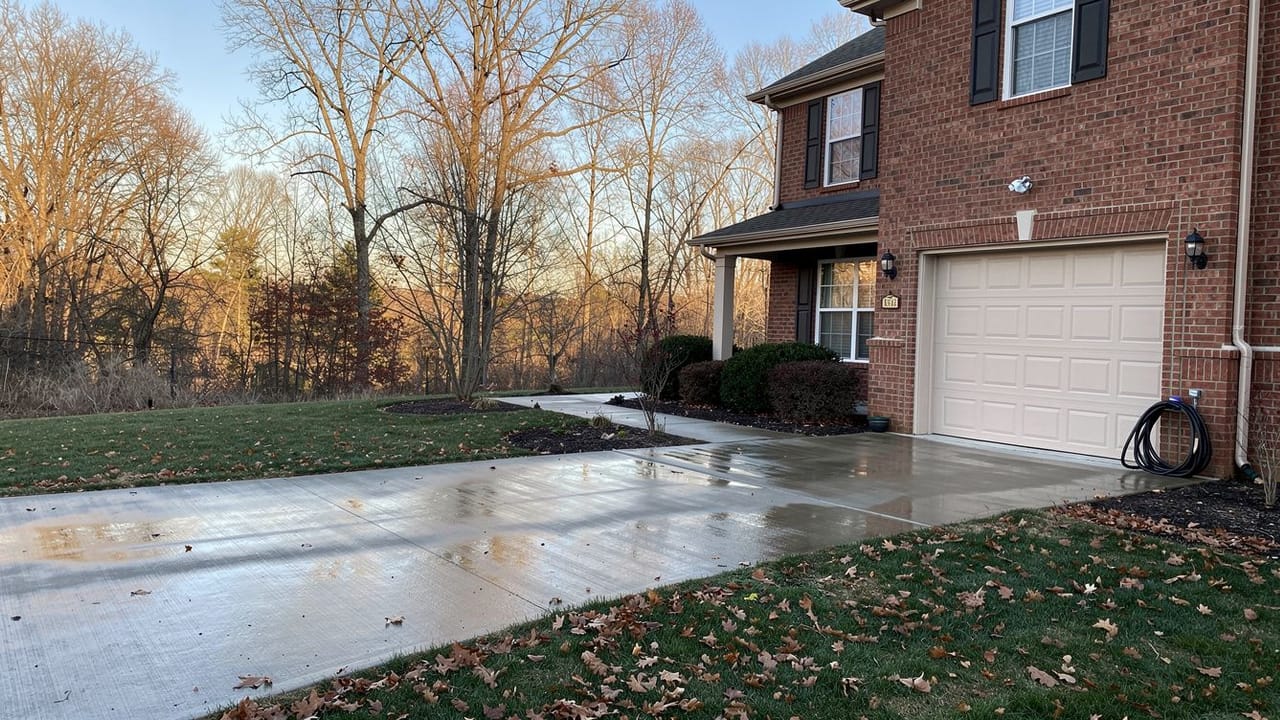
On a mild, dry day with sun on the surface and no freeze due that night, a driveway or walk can be washed in winter the same way as any other time of year. Leaves, mildew and grime come off, and the surface is dry before dark.
Some work is better left for spring. A shaded walk on the north side of a house may not dry before night in December, and a slab that is going to be sealed needs the drying time and the temperatures printed on the sealer maker’s label, which usually makes sealing a warm-weather job.
If you are not sure which side of that line your job falls on, tell us what needs washing and where, and we will say whether we would do it now or book it for warmer weather, and why.
Sources
- Simpson Cleaning, King Brute hot-water pressure washer operator’s manual — Freeze damage excluded from warranty; draining and 50 percent antifreeze for freezing weather; flushing antifreeze before washing
- Federal Highway Administration, Tech Brief FHWA-HIF-17-009, Air Entrainment and Concrete Durability — Critical saturation and freeze-thaw damage in concrete
FAQ
Pressure Washing in Winter: What the Cold Changes — questions
Can you pressure wash in the winter?
Yes, on days when the washed surface can drain and dry before it freezes. The cold-weather risks are ice on walks and steps, concrete that freezes while saturated, and water freezing inside the machine. We pick mild, dry days with no freeze due the following night, and we drain the equipment afterward.
Can you pressure wash when it is freezing?
Not sensibly. Water put down in freezing weather turns to ice on the surface, and the Federal Highway Administration explains that concrete which freezes while critically saturated can be damaged. A washer’s pump, hoses and coil can freeze as well. We reschedule rather than wash into a freeze.
How do you keep a pressure washer from freezing?
Keep it somewhere heated, or winterize it. One manufacturer’s manual says to drain the machine and pump a 50 percent solution of permanent-type antifreeze through it until it flows from the wand, then pump the antifreeze back out before washing, since it can damage paint. Follow your own machine’s manual.
Does pressure washing in winter damage concrete?
The washing is not the problem; freezing while saturated is. The Federal Highway Administration explains that concrete frozen in a critically saturated state can be damaged, while concrete with its larger pores still empty is not. So we wash concrete in cold weather only when it can drain and dry before temperatures fall below freezing.
Is it worth pressure washing in the winter?
It can be, on a mild, dry day. Grime, mildew and leaf stains come off in winter too, and the work does not have to wait for spring. A shaded surface that will not dry before night, or a slab that is going to be sealed, is usually better left for warmer weather.
What temperature is too cold to pressure wash?
We found no primary source that sets one. The equipment manual and the federal concrete brief we rely on describe water freezing in the machine and in saturated concrete, not a cut-off number. So we judge each day by whether the surface can dry, and the machine can be drained, before it freezes.