
· by Michael Blair, Nashville's Pressure Washing
Composite decking is sold as low maintenance, and it is, but low is not none. Around Nashville the boards collect a spring coat of pollen, a fall of oak and maple leaves, and enough humid shade to grow mildew on top of both. Owners who have washed a wood deck for years tend to reach for the same pressure washer, and that is where composite needs more care.
The rules come from the board makers, and they do not agree with each other.
Can you pressure wash a composite deck?
Yes, within the limit set by whoever made your boards, and those limits differ by half. Trex’s care and cleaning page allows a pressure washer of no more than 3,100 psi with a fan attachment, held no closer than 8 inches, on its Transcend, Enhance and Select lines, and says going higher could damage the boards and void the warranty. On its early-generation boards, Trex does not recommend a pressure washer at all.
The TimberTech Care and Cleaning Guide allows a power washer only for rinsing, with a fan tip, at no more than 1,500 psi, sprayed along the grain and never across it. Fiberon’s general questions page says skilled professionals may use wide fan tips under 3,000 psi, 12 inches above the deck. So the first thing we ask is what brand and line the deck is, and when nobody knows, we work to the lowest of the three.
Should you power wash a composite deck that has mold on it?
No, not according to Fiberon. Its general questions page advises against power washing while mold or mildew is on the boards, because the pressure only makes the mold worse. The cleaner does that work, and the water only rinses it away.
Composite grows mold for a plain reason. Trex explains that pollen and dirt left on the boards for a long stretch leave a film that mold feeds on, and TimberTech’s FAQ says surface mold on its decking does not go through the board. Middle Tennessee supplies both halves of that, with heavy spring pollen and humid summers. Shaded corners and the gaps between boards stay damp the longest, and TimberTech’s guide asks owners to keep those gaps clear of dirt and leaves so the deck drains and dries.
What cleaner is safe on composite decking?
Soap, water and a soft brush handle most of it. Trex’s answer for mold on its decking is warm, soapy water and a soft-bristle brush, and it warns that products containing bleach or acid will lighten the surface, so they should be tried somewhere out of sight first. TimberTech recommends its own bleach-free DeckCleaner, one part to three parts water, and its FAQ allows a one-to-four mix of bleach and water for surface mold.
TimberTech also warns against several common composite deck cleaners on its current capped boards, because the cap is not a wood and plastic composite, and it says not to clean in direct sun, where the cleaner can dry before it is rinsed. Leaf stains are their own case. Trex lifts tannins on its current lines with a deck brightener containing oxalic acid, and TimberTech says the marks usually weather away over 8 to 10 weeks. Fiberon asks for a cleaning at least twice a year.
How we wash a composite deck
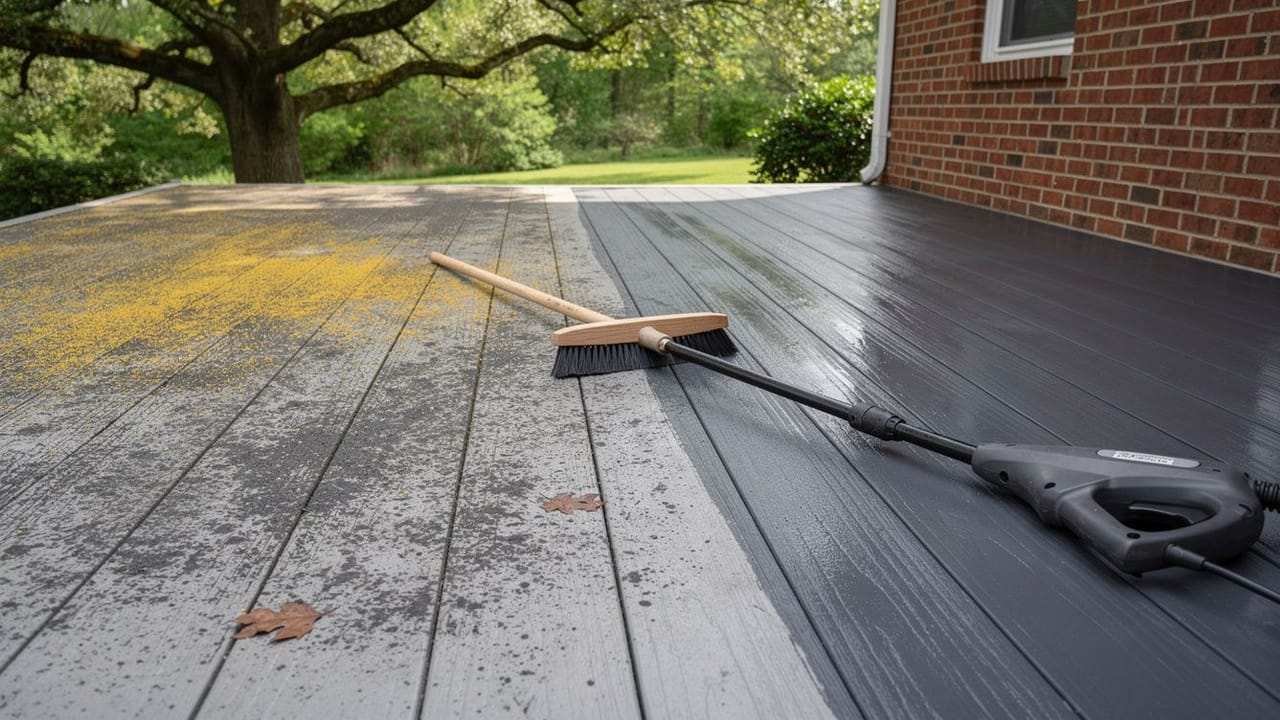
Our deck and fence cleaning on composite starts with the brand, then the cleaner, and the pressure comes last. We clear the gaps between boards, wet the deck and the plants around it, apply a cleaner suited to the boards, let it work out of direct sun, brush along the boards and rinse along the grain with a wide fan tip at low pressure. Mold spots get a second round of cleaner rather than more pressure.
Wood decks are a different job with different chemistry, covered in our post on cleaning a deck before sealing, and the low-pressure method behind both is in soft washing explained. Winter brings one more split between the brands: Trex allows calcium chloride or rock salt on its boards, while TimberTech asks owners to avoid rock salt. If your composite deck in Brentwood or nearby has gone gray or spotted, ask us for an estimate and tell us the brand if you know it.
Sources
- Trex, Care and Cleaning — Pressure washer no greater than 3,100 psi with fan attachment, no closer than 8 in.; higher could damage boards and void the warranty; not recommended on early-generation decking; mold feeds on pollen and dirt biofilm; soapy water and soft-bristle brush; bleach or acid lightens the surface; deck brightener with oxalic acid for tannins; calcium chloride or rock salt for ice
- TimberTech, Care and Cleaning Guide — Power washer for rinsing only, fan tip, 1,500 psi maximum, with the grain; DeckCleaner one part to three parts water; avoid certain composite deck cleaners on capped boards; no cleaning in direct sun; keep gaps between boards clear; tannins weather away in 8 to 10 weeks; avoid rock salt
- TimberTech, Frequently Asked Questions — Surface mold does not penetrate the deck board; DeckCleaner or a 1-to-4 mix of bleach and water for surface mold
- Fiberon, General FAQs — Wide fan tips under 3,000 psi, 12 in. above the deck; power washing not recommended while mold or mildew is present; clean at least twice a year
FAQ
Pressure Washing a Composite Deck Safely — questions
How much pressure can Trex decking take?
Trex allows a pressure washer of no more than 3,100 psi on its Transcend, Enhance and Select decking, with a fan tip held at least 8 inches from the boards, and says higher pressure could damage them and void the warranty. It does not recommend pressure washing its early-generation boards at all.
Can you use bleach on composite decking?
Some makers allow it with care. TimberTech’s FAQ lists a one-to-four mix of bleach and water for surface mold, while Trex warns that products containing bleach or acid will lighten its decking and says to test them in an inconspicuous spot first. For routine cleaning, both start with soap and water.
How often should a composite deck be cleaned?
Fiberon says to clean its decking as often as needed and at least twice a year, and Trex points to pollen and dirt left on the surface as what mold feeds on. Around Nashville, one cleaning after the spring pollen and another after the leaves come down covers most decks.
Can you use rock salt on a composite deck?
It depends on the brand. Trex says calcium chloride or rock salt may be used to melt ice on its decking, cleared with a plastic shovel. TimberTech says most calcium chloride products can be used but may leave a white residue, and it asks owners to avoid rock salt and abrasive ice melt.
How do you get leaf stains off composite decking?
Trex treats leaf and tannin stains on its current decking with a deck brightener containing oxalic acid, applied once the debris is cleared and the deck has dried. TimberTech says those marks usually weather away with rain and sun over 8 to 10 weeks. Test any brightener on a hidden board first.